
Jabal al-Rahmah, often known as the Mount of Mercy, is one of the most recognizable landmarks associated with the Hajj pilgrimage. Located on the plain of Arafat, east of Makkah, the hill holds a special place in Islamic tradition and remains an important destination for millions of pilgrims. Although the hill itself is modest in size, its religious and historical associations give it a significance that reaches far beyond its physical appearance.
The importance of Jabal al-Rahmah is closely connected with the Day of Arafah, which occurs on the ninth day of Dhul-Hijjah during Hajj. Pilgrims gather across the vast plain of Arafat to devote the day to prayer, remembrance of Allah, supplication, and reflection. This period is regarded as one of the central moments of the pilgrimage. The hill is situated within the wider area of Arafat, but pilgrims do not need to climb it for the rites of Hajj to be valid. The entire plain of Arafat is considered the place of standing, or wuquf.
The name “Mount of Mercy” reflects the spiritual atmosphere associated with Arafat. Islamic tradition connects the area with the Prophet Muhammad’s ﷺ Farewell Pilgrimage, during which he delivered his famous sermon and taught the Muslim community important principles concerning faith, human dignity, justice, and social responsibility. The Farewell Sermon continues to be remembered as an important moment in Islamic history.
Jabal al-Rahmah has also become associated in popular tradition with the meeting of Prophet Adam and Hawwa after their descent to earth. This story is widely mentioned in Islamic culture, although the Qur’an does not specifically identify Jabal al-Rahmah as the place where they met. Visitors may therefore encounter different accounts about the hill’s historical associations, and it is useful to distinguish established religious teachings from later traditions.
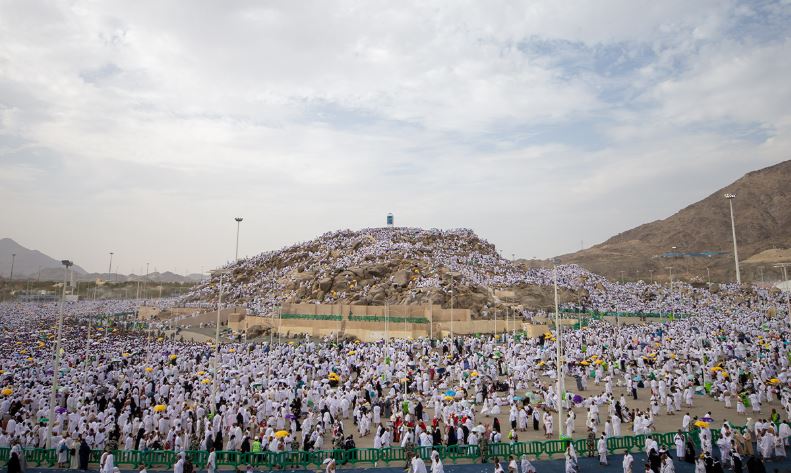
For visitors, the experience of Jabal al-Rahmah is often less about sightseeing and more about reflection. During Hajj, the surrounding plain becomes filled with pilgrims from different countries, languages, and cultures. Seeing such a diverse gathering united in worship can be a deeply moving experience. The simplicity of the landscape also encourages visitors to focus on prayer and contemplation rather than physical attractions.
Umrah Package from Dubai Sharjah and Ajman
Those visiting the area should remember that climbing Jabal al-Rahmah is not a required part of Hajj. Spending the Day of Arafah in the designated area of Arafat is the essential act. Visitors should also follow official instructions, respect crowd-management arrangements, stay hydrated, and avoid creating unnecessary congestion around the hill.
Outside the Hajj season, the landscape of Arafat can appear remarkably different from the scenes witnessed during the pilgrimage. During Hajj, however, the area takes on extraordinary importance as pilgrims gather for one of the defining stages of their spiritual journey.
Umrah Package by Bus from Dubai Sharjah and Ajman
Jabal al-Rahmah therefore represents more than a hill in the landscape around Makkah. Its importance comes from its connection with Arafat, the Day of Arafah, the Prophet Muhammad’s ﷺ Farewell Pilgrimage, and centuries of Muslim remembrance. For visitors, understanding this background can make a visit more meaningful. Rather than viewing the hill simply as a landmark to photograph, it can be approached as a place that invites humility, remembrance, prayer, and reflection on the deeper purpose of the pilgrimage.