

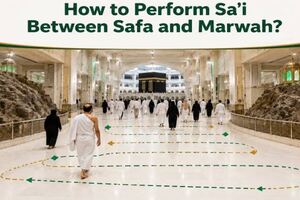
Sa’i is one of the important rituals of Umrah and Hajj. It involves walking seven times between the hills of Safa and Marwah in Masjid al-Haram in Makkah. This act of worship commemorates the struggle and trust of Hajar (peace be upon her), who searched for water for her infant son Ismail (peace be upon him). Sa’i is therefore not simply a physical walk; it is a reminder of patience, faith, determination, and complete reliance upon Allah.
Preparing for Sa’i
Before beginning Sa’i, pilgrims should make sure they have completed the required Tawaf. After Tawaf, it is customary to pray two rak‘ahs if possible and then proceed toward Safa. Sa’i does not require a separate special clothing style beyond the requirements already applicable to the pilgrim. The most important preparation is to approach the ritual with sincere intention and awareness that it is an act of worship.
Starting at Safa
Sa’i begins at Safa. As you approach the starting point, remember Allah and make your intention to perform Sa’i for His sake. You do not need to recite a particular lengthy formula throughout the ritual. You may make supplications, praise Allah, recite the Quran, or remember Him in words that are meaningful to you.
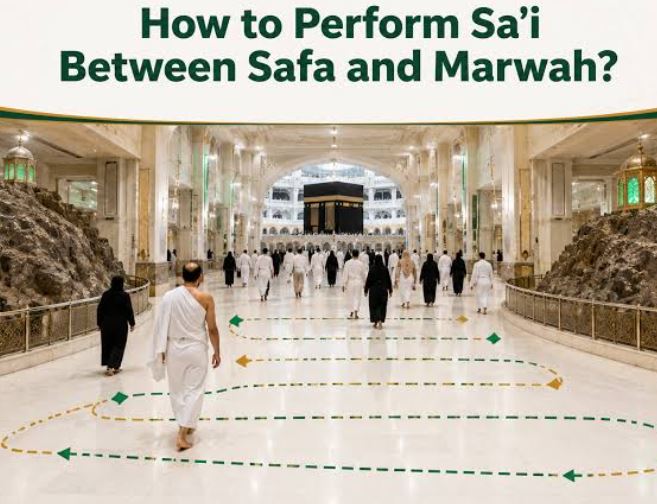
From Safa, walk toward Marwah. This first journey counts as one lap.
Walking Between Safa and Marwah
The complete Sa’i consists of seven laps. The sequence is:
- Safa to Marwah — 1st lap
- Marwah to Safa — 2nd lap
- Safa to Marwah — 3rd lap
- Marwah to Safa — 4th lap
- Safa to Marwah — 5th lap
- Marwah to Safa — 6th lap
- Safa to Marwah — 7th lap
The ritual finishes at Marwah.
Pilgrims should walk calmly and avoid pushing or rushing others. Along the route, there are marked areas associated with the place where Hajar hurried while searching for water. Men traditionally walk briskly between these markers, while women continue at their normal walking pace. The purpose is to remember Hajar’s urgency and determination rather than to turn the ritual into a race.
What to Recite During Sa’i
There is no requirement to recite a specific supplication for every lap. This gives pilgrims an opportunity to communicate with Allah sincerely in their own words. You can ask for forgiveness, guidance, good health, family well-being, success in the Hereafter, and acceptance of your worship.
Umrah By Bus Packages from Dubai UAE
It is also perfectly appropriate to recite the Quran, send blessings upon the Prophet Muhammad (peace and blessings be upon him), or quietly engage in dhikr. Try to keep your heart focused on worship rather than becoming overly concerned about memorizing a particular prayer for every section.
Completing the Seventh Lap
When you reach Marwah after completing the seventh lap, Sa’i is finished. Unlike Tawaf, there is no separate prayer that must be performed immediately after Sa’i. If you are performing Umrah, the next major step is to complete the ritual of shaving or trimming the hair. Men generally shave or shorten their hair, while women trim a small portion of their hair. Once this is completed according to the requirements of Umrah, the state of Ihram ends.
The Spiritual Meaning of Sa’i
Sa’i teaches a powerful lesson about effort and trust in Allah. Hajar did not simply sit and wait for help; she took action while placing her trust in her Creator. Her determination is remembered by millions of pilgrims centuries later.
Umrah by Air Packages from Dubai UAE
As you walk between Safa and Marwah, remember that worship can involve both patience and effort. Sa’i encourages Muslims to continue striving even when circumstances seem difficult, while trusting that Allah knows what is best.
Approach the ritual with humility, patience, and sincerity. Rather than focusing only on counting the seven laps, allow each step to become an opportunity for remembrance, reflection, and heartfelt prayer.