

Umrah is a deeply spiritual journey to Makkah that gives Muslims an opportunity to worship Allah, seek forgiveness, make sincere supplications, and renew their faith. Unlike Hajj, Umrah can generally be performed throughout the year. For someone performing Umrah for the first time, the rituals may seem complicated, but the basic process is straightforward. Umrah consists of four main stages: entering Ihram, performing Tawaf, completing Sa’i, and shaving or trimming the hair. Understanding these steps in advance can help pilgrims remain calm, focused, and confident throughout the journey.
Umrah Package from Dubai for Family
The first step is to enter the state of Ihram before crossing the Miqat, the designated boundary for pilgrims intending to perform Umrah. Before entering Ihram, it is recommended to perform Ghusl, clean yourself, and prepare mentally and spiritually for the pilgrimage. Men generally wear two pieces of simple, unstitched white cloth, while women wear modest clothing suitable for worship. At or before the Miqat, the pilgrim makes the intention, or Niyyah, to perform Umrah and begins reciting the Talbiyah: “Labbayka Allahumma labbayk.” The Talbiyah expresses the pilgrim’s response to Allah’s call and is repeated while travelling toward Makkah. Once in Ihram, pilgrims must observe the restrictions associated with this sacred state.
Umrah Package by Bus from Dubai for Family
After reaching Masjid al-Haram in Makkah, the next major ritual is Tawaf. Tawaf means circumambulating the Kaaba seven times in an anticlockwise direction. Before beginning, the pilgrim should ensure that they are in a state of Wudu. Tawaf starts from the area of the Black Stone. If it is possible to approach it safely without pushing or disturbing others, a pilgrim may touch or gesture toward it while saying “Allahu Akbar.” The Kaaba remains on the pilgrim’s left side throughout the seven circuits. During Tawaf, pilgrims can make personal Dua, remember Allah, and ask for forgiveness, guidance, mercy, and blessings. There is no need to memorize a different Dua for every circuit. The most important thing is to worship sincerely while maintaining patience and consideration for other pilgrims.
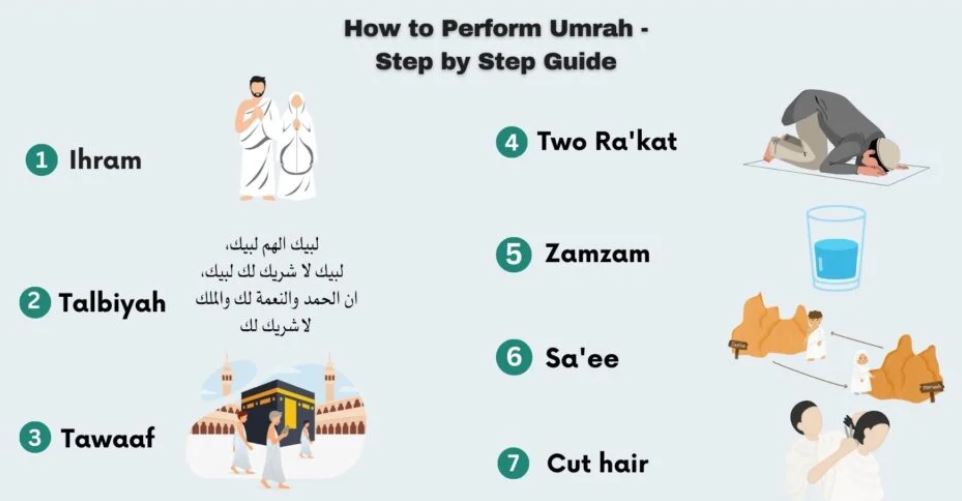
After completing the seven circuits, pilgrims generally perform two Rak’ahs of prayer if possible, preferably near Maqam Ibrahim without causing inconvenience to others. They may also drink Zamzam water and make Dua. The next stage is Sa’i, which commemorates the search for water by Hajar, the mother of Prophet Ismail. Sa’i begins at Safa and ends at Marwah. Pilgrims travel seven times between these two points, with the journey from Safa to Marwah counted as one and the return to Safa counted as another. During Sa’i, pilgrims may recite Dua, Dhikr, and the Quran or simply reflect upon Allah’s mercy and the spiritual meaning of the ritual. Men may walk more briskly between the designated green markers where appropriate, while maintaining respect for the people around them.
The final step is Tahallul, which means leaving the state of Ihram by shaving or trimming the hair. Men may shave the entire head or trim their hair, while women trim a small portion of their hair according to the applicable Islamic guidance. Once this step is completed, the restrictions of Ihram end and the Umrah is complete. Pilgrims can then change into their regular clothing and continue their worship in Makkah.
Umrah Package by Air from Dubai for Family
Performing Umrah is not simply about completing a sequence of physical actions; it is an opportunity to strengthen one’s relationship with Allah. Pilgrims should approach every stage with sincerity, patience, humility, and respect for fellow worshippers. Preparing beforehand, learning the basic rituals, keeping track of the seven circuits and seven journeys, and avoiding unnecessary rushing can make the experience much easier. Most importantly, remember that Umrah is an act of worship, so the goal is not merely to finish the rituals but to perform them with a sincere heart and devotion to Allah.